 Fraunhofer Institute for Process Engineering and Packaging IVV
Industrial cleaning
Your expert partner for hygienic production, cleaning, and sterilization
Today, industrial cleaning is faced with increasing demands for efficiency and precision more than ever before. In view of growing quality requirements and simultaneous cost pressure, we offer you innovative cleaning technologies and processes that are carefully selected regardless of manufacturer and taking into account technical and economic criteria. Our goal is not only to make cleaning easier for you, but also to make it an integral part of your process efficiency and safety.
Due to the increasing shortage of skilled workers, adaptive systems and autonomous robots will help to carry out safe cleaning processes with few personnel. Together, we will find the right solution for your company size. Our specialized sensor technology detects contamination in real time and enables demand-oriented process control.
We use simulations to optimize your cleaning processes in advance, without the need for costly testing in the production environment. Assistance systems later support your staff's understanding of the process. We train your staff directly in the process and use machine learning to permanently eliminate or completely prevent malfunctions.
Our solutions are customized and documented step by step to meet your requirements in order to maximize safety and efficiency. Our cleanability tests and customized hygienic design solutions make a decisive contribution to compliance with hygiene standards, whereby we always work in accordance with the latest EHEDG and GFSI guidelines.
In addition, we contribute to the effectiveness of your disinfection and sterilization processes with microbiological validations, thus ensuring quality and safety along your value chain. With intelligent tank cleaning solutions that automatically adapt to process conditions, we avoid oversizing and increase process efficiency.
In addition to cleaning in the production environment, we are proven experts in the field of component cleaning. We don't just see this as a cleaning process, but as a value-adding step for which we develop comprehensive solutions for design, monitoring, and digitalization.
With our approaches, you can be sure of optimal cleaning processes with the highest quality, efficiency, and sustainability!
Take part in our events!
We present trends and the latest technologies for use in production at trade fairs and regular events.
Innovative cleaning processes for industrial applications
Would you like to automate cleaning processes and use the latest, most efficient systems?
Benefit from our long-standing, manufacturer-independent expertise in both common and innovative cleaning, sensor, and automation technologies. We enable you to run your cleaning processes reliably and reproducibly, while achieving near-optimal efficiency.
Our cleaning systems are continuously being developed to meet even the most demanding requirements in the future. Special multi-sensor systems can already support humans and machines with the data required for safe process control to an unprecedented extent, and we are continuing to research these systems.
We work with you to develop customized automation solutions!
Adaptive cleaning systems and robotics
Would you like to say goodbye to your worst-case scenario-based and therefore oversized cleaning process? Would you like to waste fewer resources and reduce cleaning time?
With our work on adaptive cleaning systems, we support the paradigm shift from experience-based to model-based design, parameterization, and control!
Using multi-sensor technology, we implement systems that detect the necessary cleaning effort based on the type, condition, and quantity of contamination or product residues. Flexible cleaning systems with a high degree of freedom (e.g., robots) use this information to clean with pinpoint accuracy.
How about having your machinery, equipment, or even your entire production environment cleaned by intelligent cleaning robots in a reproducible, demonstrably safe, yet flexibly tailored manner according to your needs? Take advantage of our Mobile Cleaning Devices (MCD) and our customized solutions for robot-assisted internal cleaning of your systems, or for cleaning production rooms (e.g., cooling chambers, cooking rooms), or for the entire production environment. In addition, a wide range of powerful systems for adaptive, need-based tank cleaning are already available.
If the systems currently available do not meet your requirements, we will work with you to develop a customized solution.
We accelerate the automation of your cleaning!
Cleanability tests & hygienic design
The cleanability of your products can be visualized, quantified and validated!
We have a unique method using fluorescence-based inline contamination detection, which visualizes and evaluates cleanability. In addition to a before-and-after inspection, time- and location-resolved monitoring of the entire cleaning process is possible, enabling a temporally and spatially differentiated assessment of cleanability. This allows the required cleaning time for each area of components or component groups to be determined. An individual test setup helps to convey the advantages of hygienic design components in a measurable and visual way and can also support the design development process.
We also come directly to your production facilities with our mobile contamination sensors and carry out an analysis of the cleaning processes on site. During the CIP cleaning of your tanks, for example, we precisely track contamination by location and over time, leveraging these insights to enhance cleaning efficiency and reduce resource consumption.
With our comprehensive know-how and equipment, we support you in designing your machines and processes for easy cleaning.
References:
- ACO, cleanliness of drainage channels:
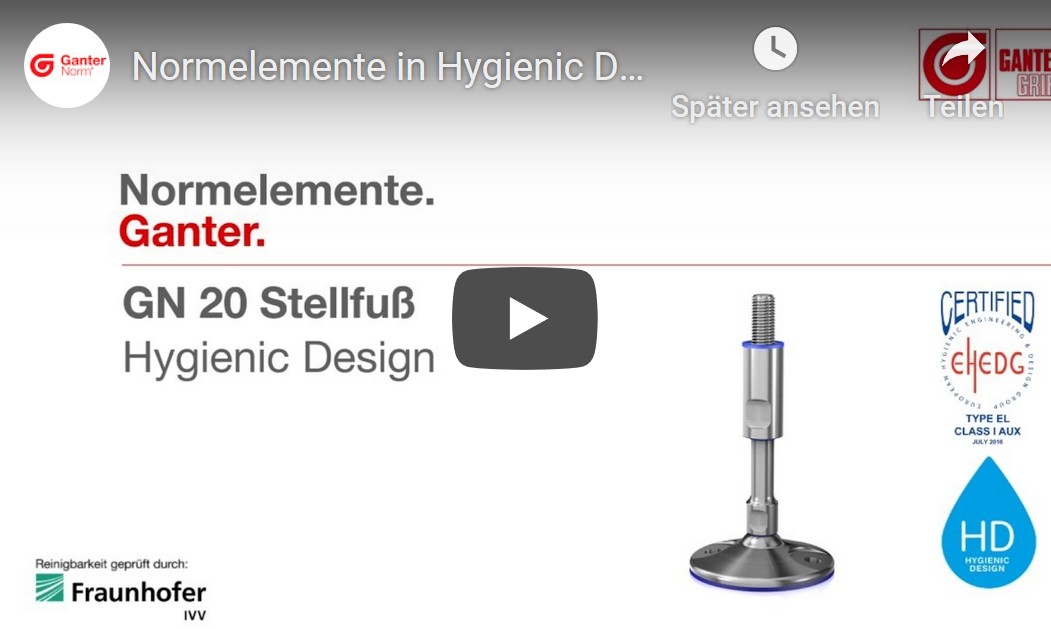
- Otto Ganter GmbH, cleanliness of machine levelling feet:
The EHEDG cleanability test for open systems
The test allows equipment and component manufacturers to evaluate their machine and plant designs based on EHEDG standards early in the development process.
Cleaning simulation
Short, efficient cleaning processes while ensuring consumer safety and product functionality are ideal from both an economic and ecological point of view. A purely experience-based design is not effective, as iterative, experimental testing is time-consuming and expensive.
To optimize industrial cleaning processes, we therefore use a variety of simulation methods tailored to the specific application and target parameters. Detailed information obtained through computational fluid dynamics (CFD) contributes to cost reduction and acceleration of development processes, as do spray shadow analysis using semi-empirical models and dimension-reduced simulation of fluid distribution.
Experience has shown that all cleaning processes – both open spray cleaning as well as closed cleaning in pipes and tanks – can be designed much more efficiently using simulation. We support you in unlocking this potential.
With our wide range of simulation methods, we optimize your cleaning processes – in a resource-saving and modern way.
Assistance systems for industrial cleaning
Industrial cleaning processes are primarily designed based on the experience of the operators. Similarly, adjustments and the elimination of problems and malfunctions are carried out based on the knowledge of operating personnel. However, the departure of experienced employees often results in a loss of know-how, which new employees can only regain and apply after a long training period. Quality problems, unnecessary use of resources, and high costs are a frequent consequence.
We develop customized digital solutions to address these challenges, including self-learning operator assistance systems. These systems enable even inexperienced personnel to quickly learn how to effectively support the elimination of faults by offering direct recommendations for action. The software combines machine learning based on historical and sensor-based system parameters with human experience, enabling the effective and efficient operation of systems and the quick rectification of faults.
Personnel are trained during the ongoing process and faults are eliminated in the long term through machine learning.
Sensors for contamination detection
Contaminants and deposits (fouling) pose a risk to downstream processes, the functional reliability of components, and ultimately consumer safety. It is therefore not only the reliable removal of such contaminants that is critical, but also the continuous monitoring of contamination-sensitive areas – ideally directly within the process.
We develop application-specific sensor and system solutions for our customers for the detection and assessment of residual contamination and fouling – depending on the application, optical (e.g. for large-area surface inspection, including complex 3D geometries), vibration-based (e.g. for inaccessible or closed, flow-through areas such as pipelines), or primarily data- and AI-driven (e.g. for real-time fouling prediction and planning of appropriate cleaning cycles).
Our solutions enable:
Our fluorescence measurement methods are suitable for:
- seamless inline or in-situ monitoring of relevant areas
- high process and product safety through reproducible cleanliness assessment
- differentiation between types and states of residues
- simple, hygienic integration into existing systems
- automated documentation and traceability (e.g. for audits)
- needs-based, resource-efficient cleaning with reduced downtime, energy, and media consumption
In this way, we support you in troubleshooting, process optimization, quality control, and sustainable process operation. The following presents selected examples from our “CoControl” (Contamination Control) sensor series
CoControl
CoControl-LumiHD
»CoControl-LumiHD« is an extremely compact hybrid system for large‑area inline contamination detection. It utilizes the fluorescence of filmic residues. Many contaminants emit light in the visible spectrum when excited with UV radiation. This signal is evaluated using imaging methods, enabling spatially and temporally resolved assessment of contamination type, condition, and quantity directly within the process.
In addition, the system combines analysis under UV and white‑light excitation. This approach considers not only fluorescence characteristics but also typical optical features of residues. As a result, detection reliability is increased and, for the first time, non‑fluorescent residues can also be identified.
The sensor is fully designed in accordance with Hygienic Design principles and is therefore suitable for use in hygienically sensitive environments.
»CoControl‑LumiHD« supports, among other applications, troubleshooting, process optimization, quality control, and automated documentation (e.g., for audits), and establishes the basis for demand‑driven, resource‑efficient cleaning processes.
CoControl-LumiLAB
»CoControl‑LumiLAB« is likewise based on fluorescence‑based, imaging cleanliness inspection for the rapid and reproducible detection of filmic contaminants. For defined measurement conditions, the system is now available in a closed measurement enclosure (alternatively as an inline application), allowing the sensor technology to be seamlessly integrated into existing inspection and production processes.
In contrast to conventional one‑ or two‑dimensional acquisition methods, »CoControl‑LumiLAB« can assign contactlessly and area‑wide detected contamination to a specific position in space. By linking the measurement data with the 3D model of the component, functional surfaces (e.g., sealing areas or joining interfaces) can be selectively evaluated for compliance with specified cleanliness requirements. This makes the system ideally suited for quality assurance, process optimization, failure analysis, and documentation of complex three‑dimensional components.
Do you have inaccessible areas where visual inspection for residual contamination is not possible? We have developed a compact sensor solution that uses vibrations to monitor minimal residues of contamination in closed systems such as pipelines. This not only enables cleaning to be carried out as required, but also allows the cleanliness status to be continuously monitored in areas with full flow.
Using artificial intelligence (AI), the occurrence of fouling in heat exchangers during production can be predicted in real time for the first time. An AI model predicts the required temperature at the heat exchanger inlet for stable heating of the product to a constant temperature.
In addition, the energy requirement increases due to the reduced heat transfer and therefore the costs for heating increase considerably. »CoControl-FouliQ« enables the energy required for heating to be evaluated and provides a basis for decisions regarding cleaning cycles.
We develop contamination sensors that keep you on the safe side when it comes to process technology!
Tank cleaning tailored to your needs
Want to say goodbye to your oversized tank cleaning processes designed for worst-case scenarios because they waste unnecessary resources? With our adaptive cleaning systems, we support the paradigm shift from experience-based to model-based design, parameterization, and control.
We work with you to analyze your cleaning processes and identify critical areas in the tank. By combining innovative sensors and tank cleaning systems, we ensure that every cleaning process is always tailored to your needs thanks to intelligent monitoring and control.
To this end, we developed the revolutionary AJC (Adaptive Jet Cleaner), the first tank cleaner that allows cleaning paths to be individually adapted to the tank geometry. This allows areas that are difficult to clean to be cleaned more intensively than less critical areas.
The further developed AJCsens also has an optical contamination sensor integrated into the device. This continuously analyzes the current contamination status and forwards the information to the intelligent control system of the AJCsens. The cleaning process is adjusted inline as required and the cleanliness status is documented at the end.
By using steam for CIP cleaning of tanks, we have achieved additional resource savings, which can lead to further reductions in your cleaning costs.
We can implement fully automatic cleaning for you: resource-saving and cost-effective!
Industrial component cleaning
Industrial component cleaning is a quality-enhancing and therefore value-adding process. Based on this conviction, we have been developing comprehensive solutions for the design, quality assurance, and digitization of cleaning processes since 2008. To achieve this, we identify and leverage optimization potential in the complex interaction of chemistry, process engineering, equipment and measurement technology, as well as in upstream and downstream processes, logistics, and staff training.
The focus of our service portfolio is the controlled generation, removal, and measurement of filmic and particulate contamination – including fluorescence-based methods – as part of cleaning and process chain analyses. In addition, we perform residual contamination analyses, in which we also determine technical cleanliness in accordance with VDA 19.1 / ISO 16232.
In our application center, you can experience future technologies for process data acquisition, operator assistance, and functional surface cleaning live and test them for your cleaning task.
The complexity of industrial component cleaning offers opportunities. With our services, you can turn these into advantages for your company!
Determination of cleanliness according to VDA 19.1/ISO 16232
Alongside film-like contaminants, particulate residues pose the greatest challenges in the manufacture of components. Would you like to optimize your cleaning processes and test new methods for removing particulate contaminants? We offer comprehensive support options for this, such as determining cleanliness requirements and ensuring compliance with VDA 19.1 / ISO 16232. We can also take film-like contamination into account, providing you with a comprehensive picture of the quality achieved.
To ensure the high standards at Fraunhofer IVV, we have established a quality management system in accordance with the requirements of DIN EN ISO/IEC 17025 and thus in accordance with ISO 9001 for testing laboratories.
For example, to reduce packaging material and petroleum-based packaging and fillers, alternative packaging materials such as cardboard/paper are increasingly being used. When cleaned components come into contact with these fiber-based materials, abrasion can occur, resulting in additional particles and fibers on the components.